
Background#
I’m Zhe-You Liu (Jason), a Software Engineer on the Airflow OSS Team at Astronomer. I focus on contributing to open source, and I’m interested in distributed systems and data engineering.
If you want to know:
- What I got out of contributing to open source
- Why Apache Airflow?
- How to start contributing to Apache Airflow?
- How to find issues to work on?
- How to write a PR?
Check out the post I wrote last year:
Becoming an Apache Airflow Committer from 0
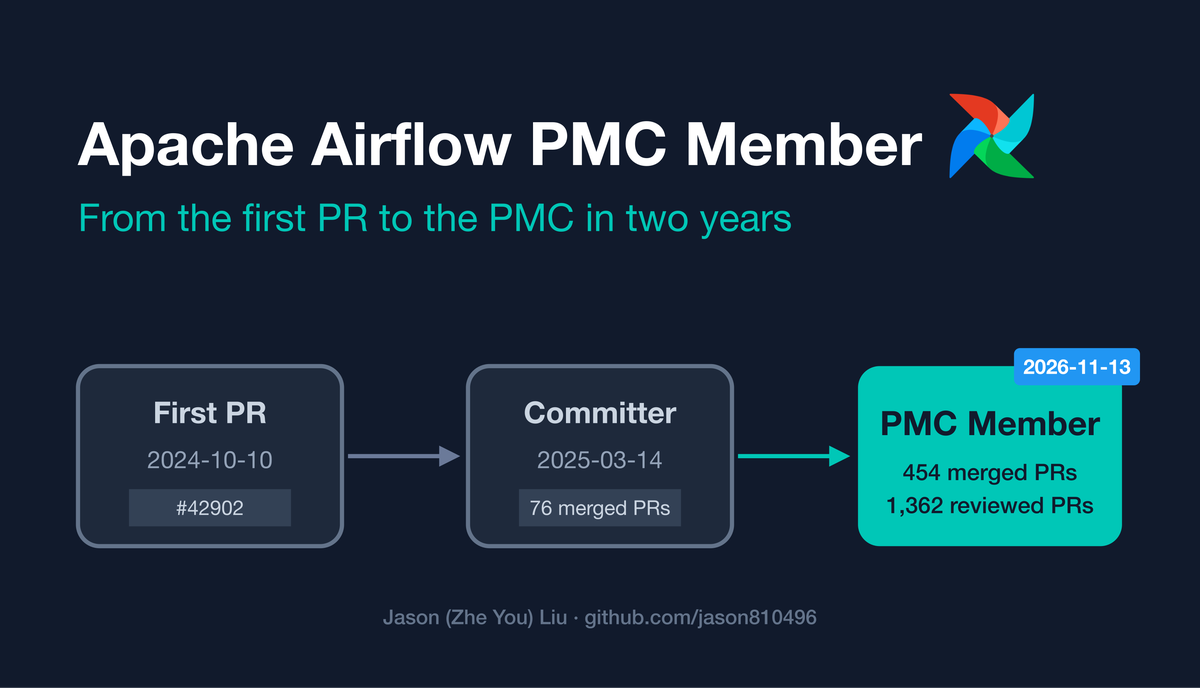
I became a Committer in March 2025. About one year and eight months later:
On November 13, 2026, I officially became an Apache Airflow PMC member!
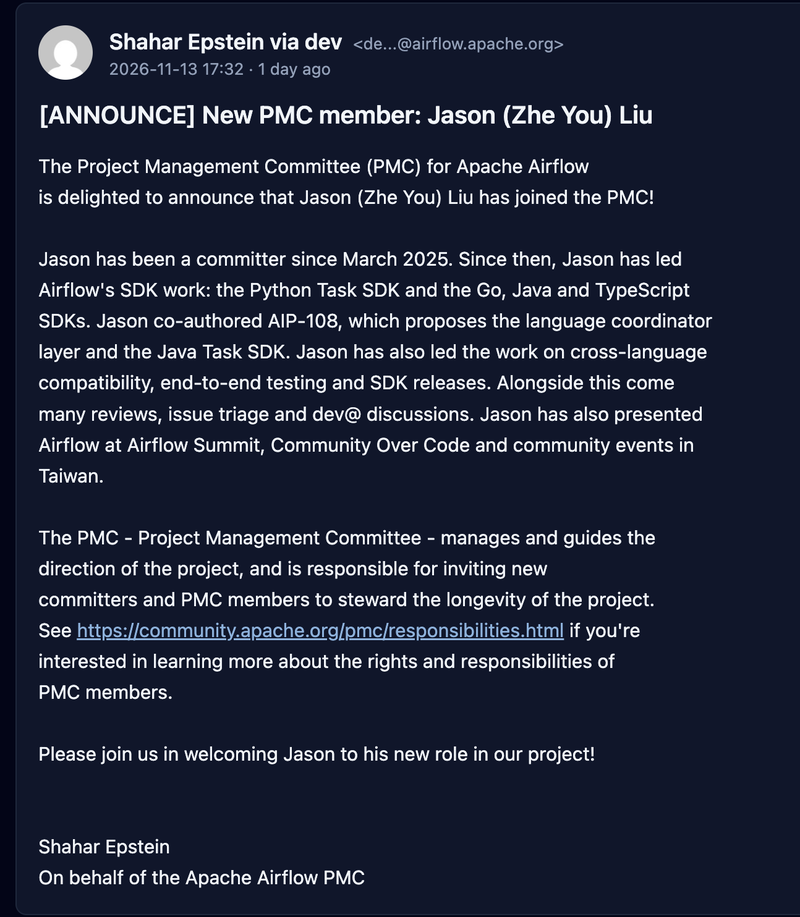
I’ve always tried to take on bigger, more impactful work to make Airflow better, and becoming a Committer and then a PMC member are milestones along the way. My responsibilities won’t change much in the short term, and I’ll keep contributing the way I have been. I also agree with what others before me have shared: what stays with you is not the moment you get a new title, but the steady work that led there.
For me, the most direct benefit of joining the PMC is that I can now handle some of the release prep myself, such as SVN access and binding release votes, without relying on others.
Some contribution stats#
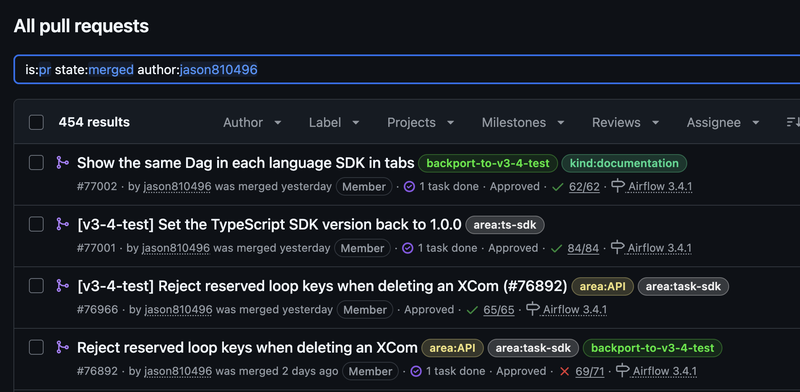
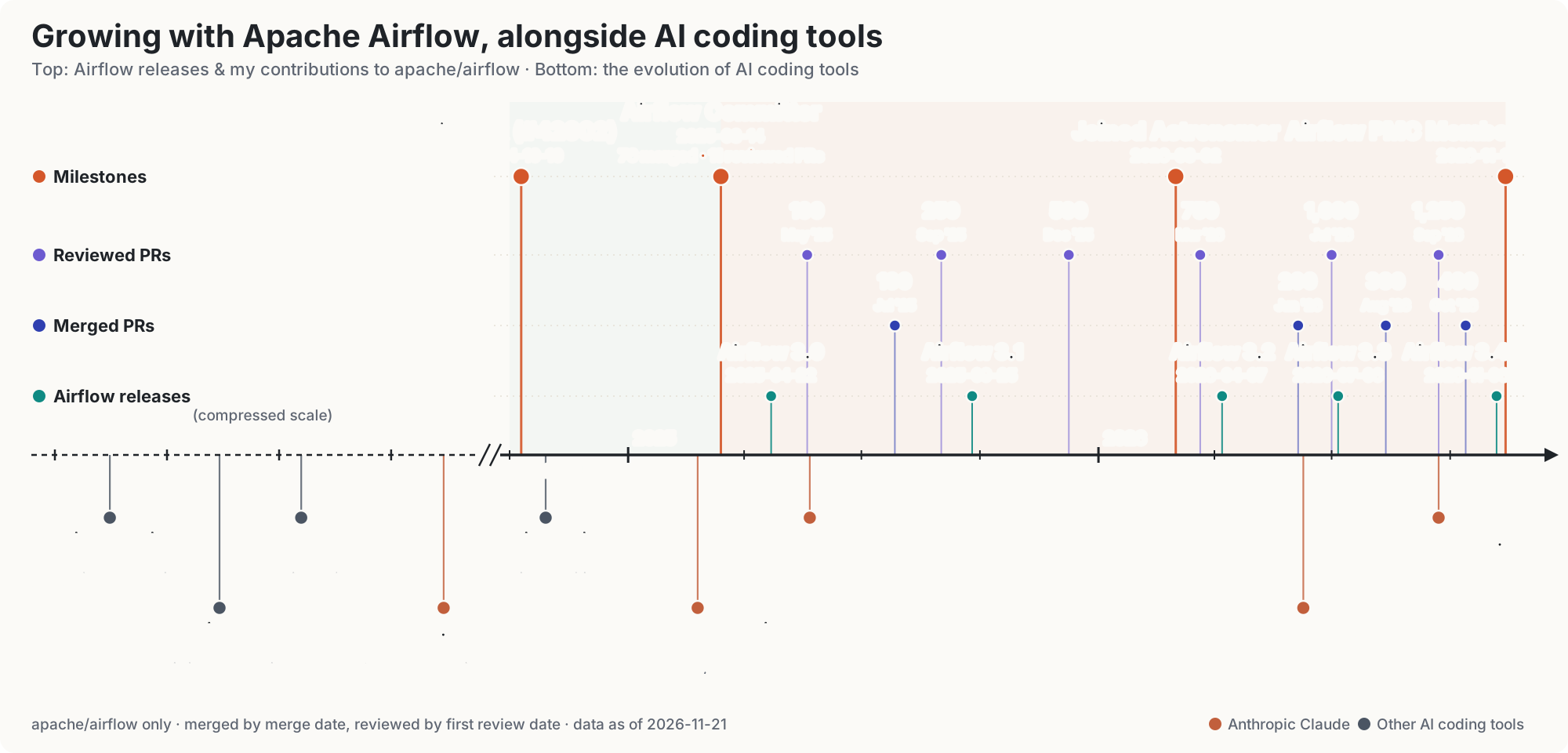
As of the day I joined the PMC, I have 454 merged PRs in apache/airflow and have reviewed 1,362 PRs from other people. That’s three times as many reviews as merged PRs.
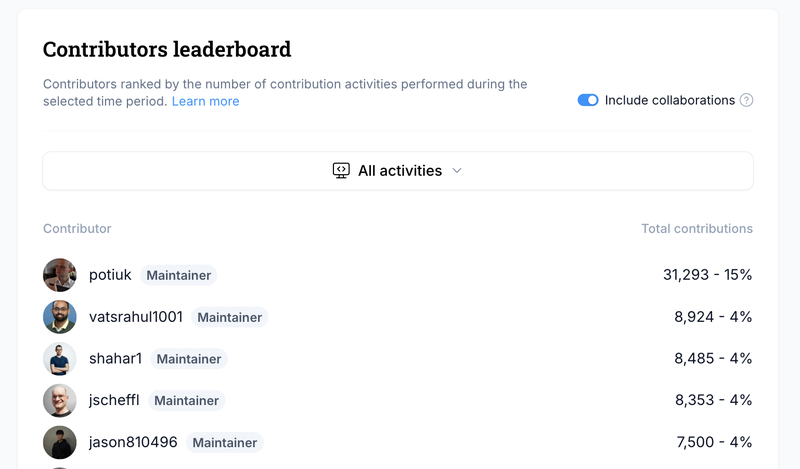
The LFX Insights Contributors leaderboard covers the past 365 days and also counts collaboration, such as reviews and comments. I’m currently fifth, and the four people ahead of me are all PMC members who have maintained Airflow for years.
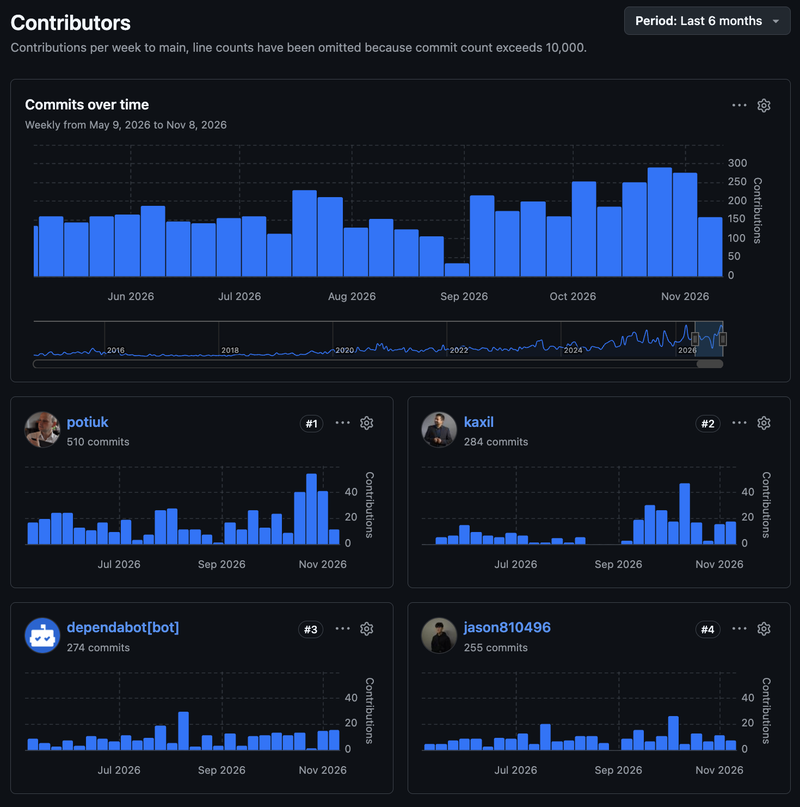
Over the last six months (May 9 to Nov 8, 2026), I’m fourth in commits to the main branch, with 255 commits.
Contributing isn’t just opening PRs#
Code review
Opening a PR is cheap now, but a person still needs just as much time to check the architecture. AI can help with code review, of course. I still read each PR myself first to catch architectural problems or anything that needs clarifying, then let AI go over the implementation details.
Joining dev list discussions
The dev list has always been where you build visibility and where the community learns you exist. I joined discussions there even before becoming a Committer. Over the past six months at work, though, I’ve been so focused on designing and building the Language SDKs that I haven’t had time to keep up with every other thread.
Opening issues
When I see the same pattern that needs fixing in many places, I open a meta issue and track the follow-up work. That way, instead of fixing everything myself, the work scales out to other contributors.
Dev calls and conferences
Whether it’s Airflow Summit or CommunityOverCode, in-person events are my chance to talk face to face with people I’ve worked with for a long time. It feels more personal than talking online, and there’s more time for longer-term topics.
Online dev calls help too, but they focus on progress updates and current blockers, so they aren’t a good place to cover many topics at once.
I wrote about CommunityOverCode EU 2026 in Glasgow and the first Airflow Contributor Day here:
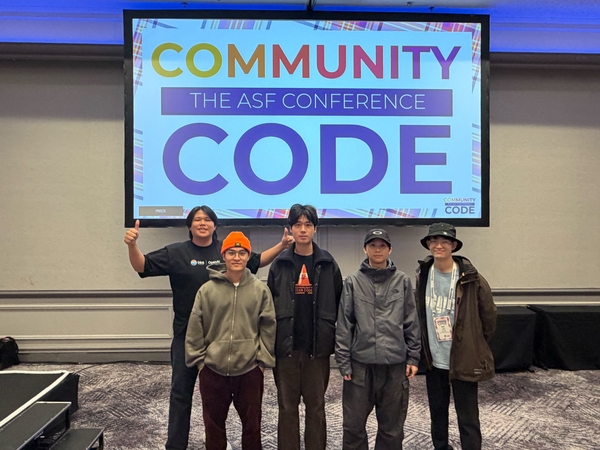
Apache CommunityOverCode Europe 2026 Recap: Airflow Contributor Day, Multi-Language SDKs, and Lakehouse Trends
What I started caring about after becoming a Committer and joining the OSS Team#
Why releases matter
- The timeline for each feature planned for a release. It affects when users and stakeholders can test and when the release ships.
- Whether a feature makes this release or slips to the next cycle.
- How a large new feature fits into the release management lifecycle. This affects compatibility across components, releases and features, as well as the long-term maintenance cost.
What I look for in fix or improvement PRs
- Is there a better mechanism that stops the same regression from happening again, instead of a one-off fix?
- Does the PR make sense at the architecture level?
- Does it affect end-to-end behavior?
- Potential performance issues. For example, Warn agents against loading the serialized Dag on hot paths #75932 covers an anti-pattern on the Airflow task execution hot path that I only learned about recently.
- Does it need a new interface, or a better one?
- How will a new interface affect future maintenance and compatibility?
What CI/CD and testing are for
- Using effective automated tests, plus beta and RC testing, to make sure a new release has no regressions. Every new feature should ship with integration and end-to-end tests from day one, so they serve as automated regression tests for future releases.
- Making sure human mistakes in operations don’t happen again. For example, the Add Milestone Tag Assistant #61626 I added still shows up on every backport PR today.
Growing with Airflow, alongside AI#
From Airflow 3.0 to the non-Python SDKs#
My first PRs, and most of my time before becoming a Committer, went into the big refactor ahead of Airflow 3.0. I worked on parts of the API server refactor and on the design of the authorization interface.
Between becoming a Committer and joining Astronomer, I first wrapped up the last 3.0 API server refactors, then mostly focused on code review and studying end-to-end paths. I also worked on provider integration for event-driven scheduling (the Common MessageQueue interface), made Breeze k8s easier to use, improved remote logging end to end, and improved Triggerer performance at scale.
In my eight months at Astronomer, I’ve mostly worked with TP on the non-Python SDKs. It started with the Java SDK. The Go SDK then moved from being driven by the Edge Worker to using the coordinator interface, so it can now run on any Executor. Next came the TypeScript SDK, a community initiative started by Shivam. We then went further: you can now write an entire Dag in these languages without any Python, breaking the Python-only limit Airflow has had for the past ten years.
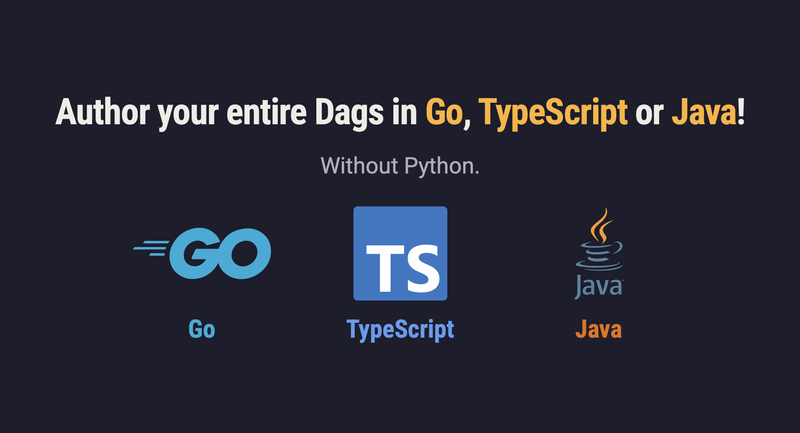
This gave me a chance to revisit what a Dag and a Task really are in Airflow. Before I could design write and read paths that every SDK can reuse, I had to understand exactly how a Task is defined and how it gets executed from start to finish.
The Language SDKs shipped as beta in Airflow 3.3.0, and each reached 1.0.0 with Airflow 3.4.0. Many major features are still under discussion. Even so, I’m looking forward to the TypeScript, Go and Java SDKs reducing the fragmentation that comes from orchestration frameworks being tied to the languages they support.
From AI-assisted contributions to working with agents#
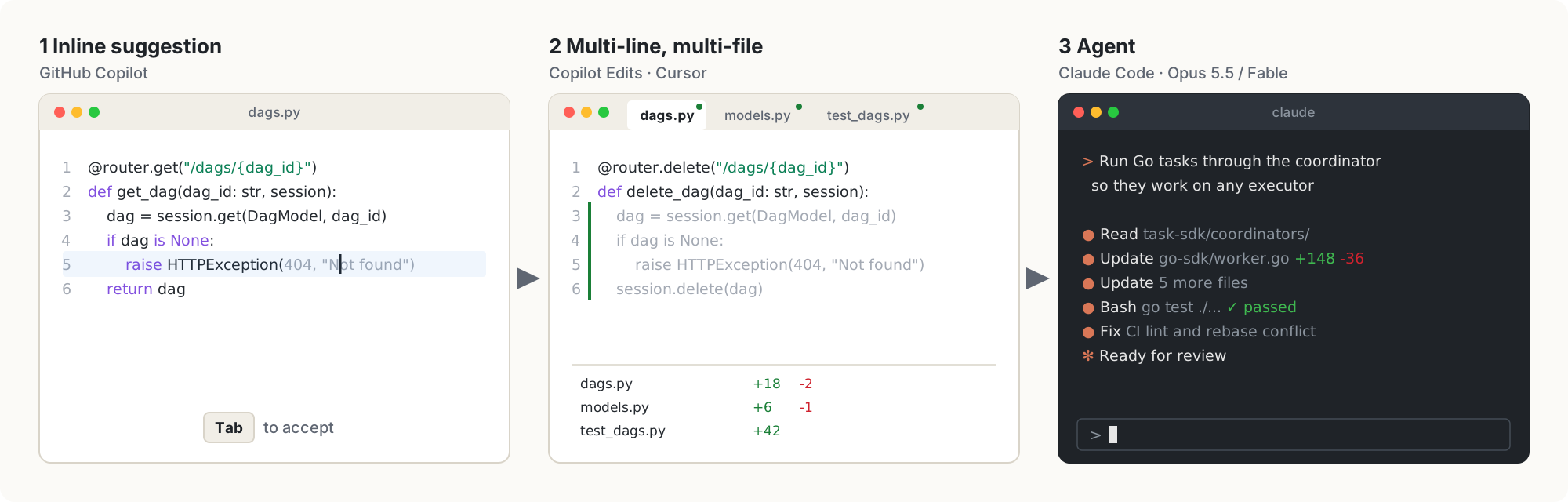
When I started contributing, I mostly used the free GitHub Copilot for short inline suggestions. I still had to walk through every module myself to understand the end-to-end path and find the exact module and function to change. Even with Copilot’s help, I’d say I wrote most of the code by hand. Unit tests, design patterns and interface design all took a lot of effort back then.
Before I joined Astronomer, GitHub Copilot had added multi-line suggestions and multi-file editing. In my early days at Astronomer I used Cursor, and I only started using Claude Code around April this year.
Now, with Opus 5.5, I no longer need to point at a specific function or module. In a domain I know well, I only need to describe the intent and roughly what the feature should do: what belongs in the control plane, what belongs in the data plane, where the boundaries between modules are, and the rough control flow. That gets the implementation 70 to 80 percent of the way there, or at least to a basic end-to-end feature.
Whether I’m designing a new feature, implementing part of one, or reviewing a PR, the most time-consuming and most valuable part is still judgment. And good judgment comes from understanding the whole system deeply over a long time.
For large features, even Fable can’t yet build the flow I have in mind in one pass. Still, these tools handle a lot of grunt work, like resolving dependency and rebase conflicts or fixing CI, which leaves me more time for architecture and interface design.
Regular review and reflection#
One practice I like on the OSS Team is that we post a daily report to a channel every day. Each morning I can look back at what I did yesterday, check whether anything needs priority today for this quarter’s goals, and see whether teammates have PRs waiting for my review. It also saves the time a standup meeting would take.
With these records, it’s easy to look back at what I did over a quarter or a year and what impact it had, or to tidy up my Claude Code skills and workflows. Right now, my way of practicing judgment is to look back and ask whether I thought deeply enough about the architecture, the end-to-end path and the trade-offs.
Where it started: OpenSource4You#
OpenSource4You is a non-profit that encourages people in Taiwan to contribute to large open source projects. The people who stay for the long run either believe in open source or simply think contributing to big open source projects is cool.
This is where I first met Chia-Ping Tsai, the founder of OpenSource4You, and Wei Lee, who mentored the Airflow channel at the time. That’s how I got started, and I’ve kept contributing ever since.
Since becoming a Committer, I’ve tried to use my free time after work to share issues I come across, directions worth contributing to, and new features with the people taking part.
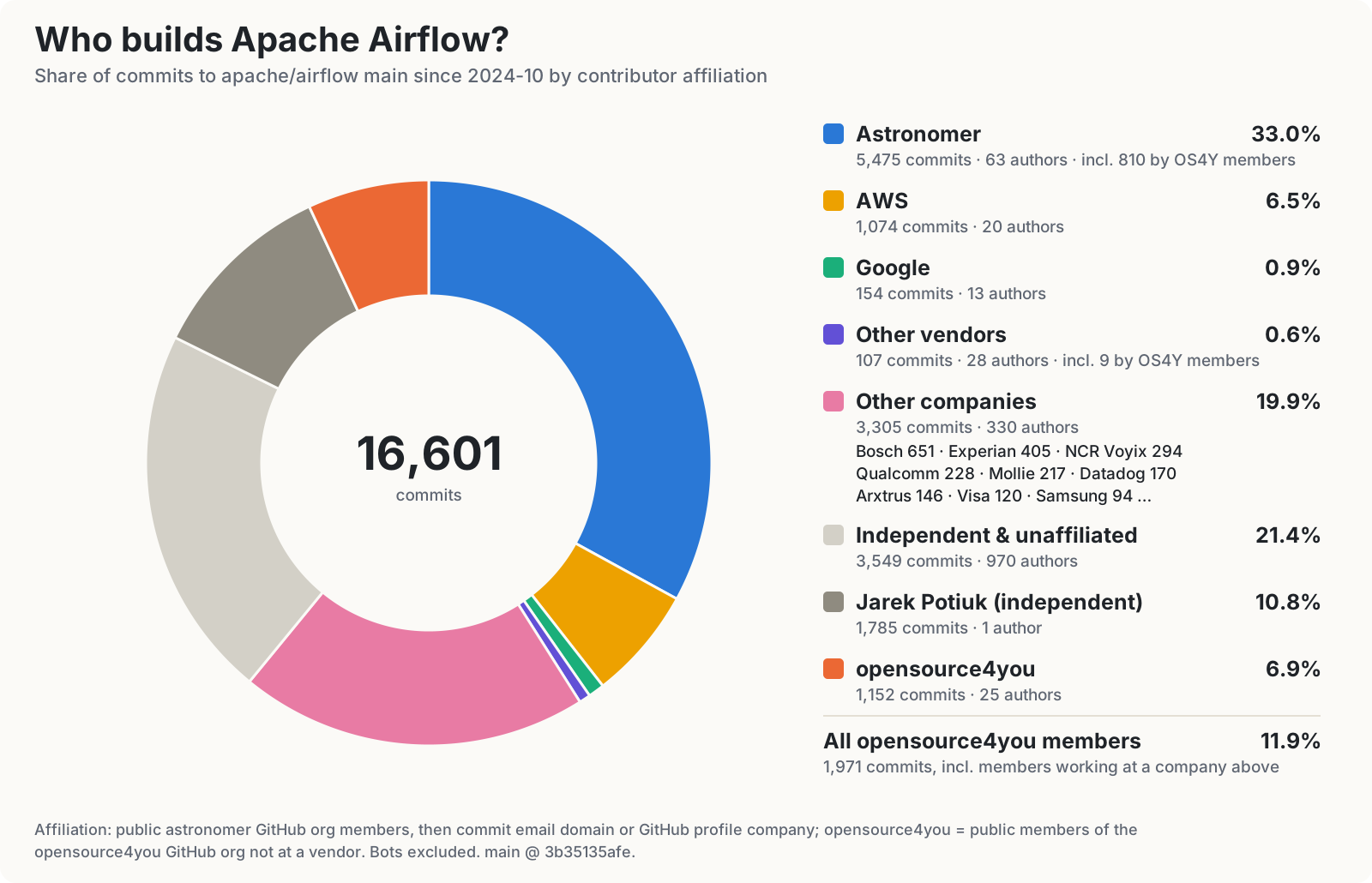
People who have taken part: Aaron Chen, Andrew Chang, ccoliu, Chao-Hung Wan, Chao-Ju Chen, ChenChen Lai, Cheng-Yi Shih, ChickenBenny, Doyeon Kim, Eric Chang, fweilun, Guan-Ming Chiu, Henry Chen, Jyun-An Chen, KUAN-HAO HUANG, Parker Chang, PoAn Yang, rjgoyln, Vic Wen, Vincent Hsiao, Wilson Josix Wang, Y-C, Ying-Fang, Yusin (Peter) Huang, Zhen-Lun (Kevin) Hong, 秀吉
PR counts don’t directly reflect impact, but many of these contributors have moved from fixing small bugs to paying down tech debt, joining technical discussions on the dev list, or proposing and building hidden gem features.
Apart from companies that offer Airflow as a service, OpenSource4You is one of the top contributing organizations, and it has had a real impact on recent Airflow releases. Its members contributed many Language SDK features, found several blockers in the 3.4.0 RC, and were already part of the big 3.0 refactor.
Airflow and the future#
I’ll keep focusing on the non-Python SDKs for now, but many community-driven AIPs (Airflow Improvement Proposals) are in the works. They aim to address users’ pain points and give users more control over their workflows.
The Common AI provider for agentic workflows recently went GA, and it’s still gaining new features. Other AI frameworks are also starting to use Airflow for durable execution: Pydantic AI already supports it, and docs integration for the OpenAI Agents SDK is in progress.
On project infrastructure, Jarek and Shahar are leading work to run CI on contributors’ forks and to use RunsOn spot instances as CI runners. A longer-term goal for maintainers is to build triage, review and release workflows on Airflow itself, using the Common AI provider and Human-in-the-Loop features. That way we dogfood our own project and keep the maintainer and user roles connected. There’s also basic but important work on trusted releases: we’re looking at Apache Trusted Releases (ATR), still in beta, to make package releases safer and less dependent on manual steps.
Special thanks#
To all the PMC members I’ve worked with: Amogh Desai, Ash Berlin-Taylor, Brent Bovenzi, Buğra Öztürk, Daniel Standish, Elad Kalif, Ephraim Anierobi, Hussein Awala, Jarek Potiuk, Jed Cunningham, Jens Scheffler, Kaxil Naik, Niko Oliveira, Pavan Kumar Gopidesu, Pierre Jeambrun, Rahul Vats, Shahar Epstein, Tzu-ping Chung, Vikram Koka, Vincent Beck, Wei Lee, Xiaodong Deng
Thank you all for your trust and encouragement. Reading the nomination thread on the private list afterwards really moved me.
My manager, Phani.
Chia-Ping Tsai, who founded OpenSource4You.
My girlfriend Iting and my family, who have supported me all along.
The views in this post are my own and do not represent my employer.