Apache Airflow’s CI System#
Continuous Integration (CI) is critical for keeping large software projects healthy. Even a tiny bug fix, a new feature, or a one-line documentation tweak can trigger different levels of integration tests to ensure nothing breaks and the project remains stable.
For example, from last month (Dec 2025) to today (Jan 14, 2026), even during Christmas and New Year’s, Apache Airflow merged 600+ PRs. Every PR triggers CI runs. These runs span from unit tests to system tests, helping catch regressions early.
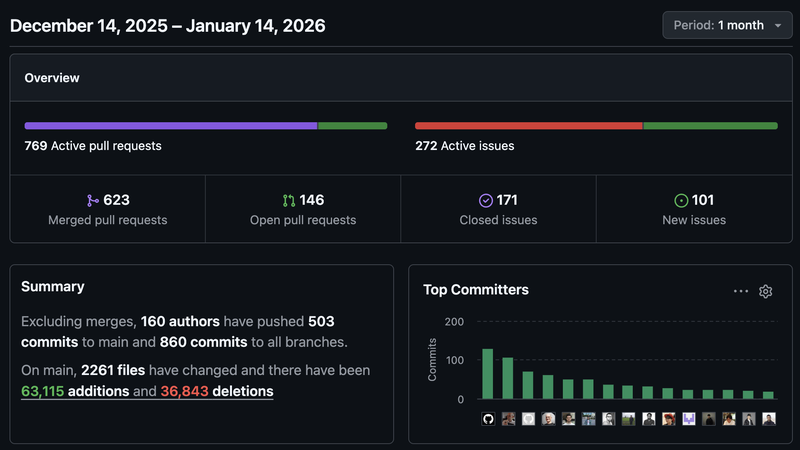
Within about a month, there were 200,000+ GitHub Actions jobs and nearly three million minutes of test time (roughly 2,000 days). At this scale, even small CI optimizations can significantly reduce total runtime and cost—while giving developers faster feedback.
This post breaks down the architecture behind Airflow’s CI and explains how it achieves:
- Reproducible environments across remote CI and local development
- Highly automated test selection based on PR changes
- Composable CI workflows
- A better developer experience (DX)
Reproducible environments#
To avoid the classic “it works on my machine” problem, Airflow’s CI relies on Docker to standardize test environments. Whether you run tests locally or in GitHub Actions, Airflow uses dedicated Docker images to keep environments consistent and reproducible.

The CI Dockerfile is roughly 2,000 lines long. It’s generated by syncing a set of bash scripts under scripts/docker into the final Dockerfile.ci. This makes it easier to share utilities and modularize dependency installation (OS packages, Python packaging tools, DB clients, third‑party service clients, etc.).
Breeze: the backbone of Airflow CI and developer experience#
We could write detailed docs listing a long sequence of commands to set up dependencies and configure a local environment. But if we provide a higher-level, well-encapsulated CLI tool, developers can set everything up with one command.
That doesn’t just improve DX. It also reduces:
- the burden of maintaining multiple setup documents
- the risk that local setup steps drift away from the real CI environment
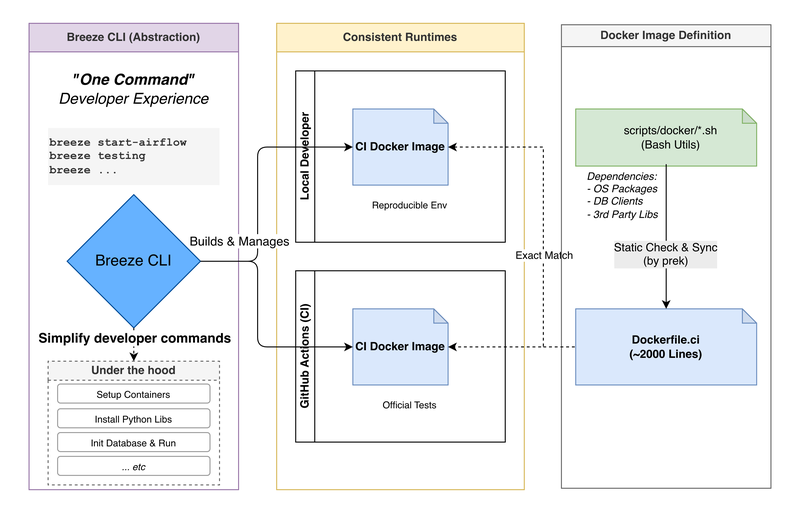
Breeze is Airflow’s CLI specifically designed for contributors. It provides a unified interface to manage development and test environments. With Breeze, contributors can emulate CI locally, bring up Airflow quickly, and run a wide range of tests and checks.
- Simple commands to start and manage the dev environment
- Automation for common checks and test flows
- The official CI environment runs the same configuration and flow as local runs: you can reproduce CI locally
What test types does Airflow CI run?#
Airflow defines 20+ CI test and check types. At a high level:
Core tests:
- Unit tests
- API tests
- System tests
Subsystem tests:
- UI tests / UI E2E tests
- Helm tests
- Kubernetes tests
- Go SDK tests
- Task SDK tests / Task SDK integration tests
- Airflow CTL tests / Airflow CTL integration tests
- WWW tests
Static checks and scans:
- MyPy (type checking)
- Python scans
- JavaScript scans
- API codegen
- CodeQL scans
Other targeted tests:
- Amazon system tests
- Providers compatibility tests (validate provider changes across multiple Airflow versions)
- Coverage
For the full list, see the FileGroupForCi definition in Selective Checks.
Recently, Airflow introduced Airflow E2E tests to validate workflows that depend on external systems—such as Remote Logging. It also has Playwright-based UI end-to-end tests to reduce UI regressions as the UI surface grows.
Airflow E2E tests and UI E2E tests are both areas with lots of room for contribution. The newer Airflow E2E tests have already caught bugs that unit tests and system tests did not—e.g. Move Airflow Config Parser to shared library #57744. With Airflow 3 doing substantial client/server migrations and refactors, E2E testing becomes increasingly important.
How does Airflow label a PR’s area of change?#
Airflow uses boring-cyborg (built by @kaxil) to automatically apply PR labels based on changed paths. This includes core subsystem labels like area:CLI, area:API, and area:Scheduler, as well as provider labels like provider:apache-cassandra and provider:apache-iceberg.
Today, those auto-applied labels are not directly used by Airflow CI. They’re primarily used for provider releases.
Key GitHub Actions primitives used in Airflow CI#
This section answers two practical questions.
How do you pass data between jobs?#
How do you do “Airflow XCom” in GitHub Actions?
An upstream job can define outputs via jobs.<job_id>.outputs.
Upstream job example
jobs:
  upstream-job:
    runs-on: ubuntu-latest
    outputs:
      output1: ${{ steps.step1.outputs.test }}
      output2: ${{ steps.step2.outputs.test }}
    steps:
      - id: step1
        run: echo "test=hello" >> "$GITHUB_OUTPUT"
      - id: step2
        run: echo "test=world" >> "$GITHUB_OUTPUT"
Any command that writes key/value pairs into $GITHUB_OUTPUT can define step outputs.
For example, you can run a Python script and append results into $GITHUB_OUTPUT:
# generate_upstream_outputs.py
import os

if __name__ == "__main__":
  with open(os.environ['GITHUB_OUTPUT'], 'a') as f:
    for i in range(3):
      f.write(f"output{i}=value-{i}\n")
Even if outputs are produced dynamically, downstream jobs can only access outputs explicitly defined under jobs.<job_id>.outputs.
In the example below, the script creates output0, output1, output2, but only output1 and output2 are exposed:
jobs:
  upstream-job:
    runs-on: ubuntu-latest
    outputs:
      # downstream job can only access outputs defined here
      # so the `generate-outputs.outputs.output0` is not accessible
      output1: ${{ steps.generate-outputs.outputs.output1 }}
      output2: ${{ steps.generate-outputs.outputs.output2 }}
    steps:
      - id: generate-outputs
        run: python generate_upstream_outputs.py
Downstream job example
Downstream jobs can reference upstream outputs via needs.<job_id>.outputs.<output_name>:
jobs:
  # Assuming upstream-job is defined above
  downstream-job:
    runs-on: ubuntu-latest
    needs: [upstream-job] # We need to declare the dependency here !!!
    steps:
      - name: Use outputs from upstream job
        run: |
          echo "Output 1: ${{ needs.upstream-job.outputs.output1 }}"
echo "Output 2: ${{ needs.upstream-job.outputs.output2 }}"- https://docs.github.com/en/actions/how-tos/write-workflows/choose-what-workflows-do/pass-job-outputs
- https://docs.github.com/en/actions/reference/workflows-and-actions/workflow-syntax#jobsjob_idoutputs
- https://docs.github.com/en/actions/reference/workflows-and-actions/workflow-syntax#jobsjob_idneeds
How do you run only specific jobs?#
How do you do “Airflow conditions” in GitHub Actions?
Use jobs.<job_id>.if to control whether a job runs.
Example
jobs:
  conditional-job:
    runs-on: ubuntu-latest
    if: ${{ github.event_name == 'pull_request' && contains(github.event.pull_request.labels.*.name, 'run-conditional-job') }}
    steps:
      - name: Run only on PRs with specific label
run: echo "This job runs only on PRs with 'run-conditional-job' label."Pruning the test matrix: Selective Checks#
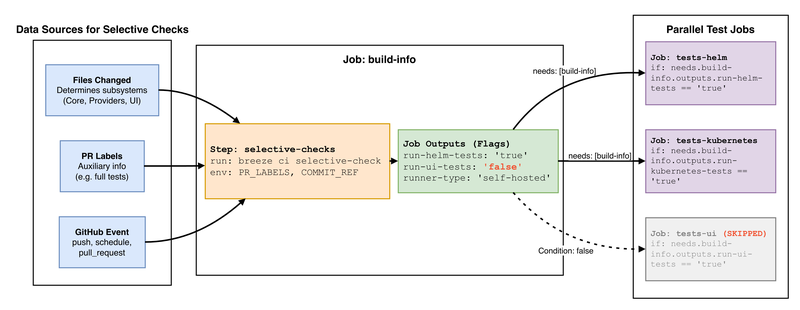
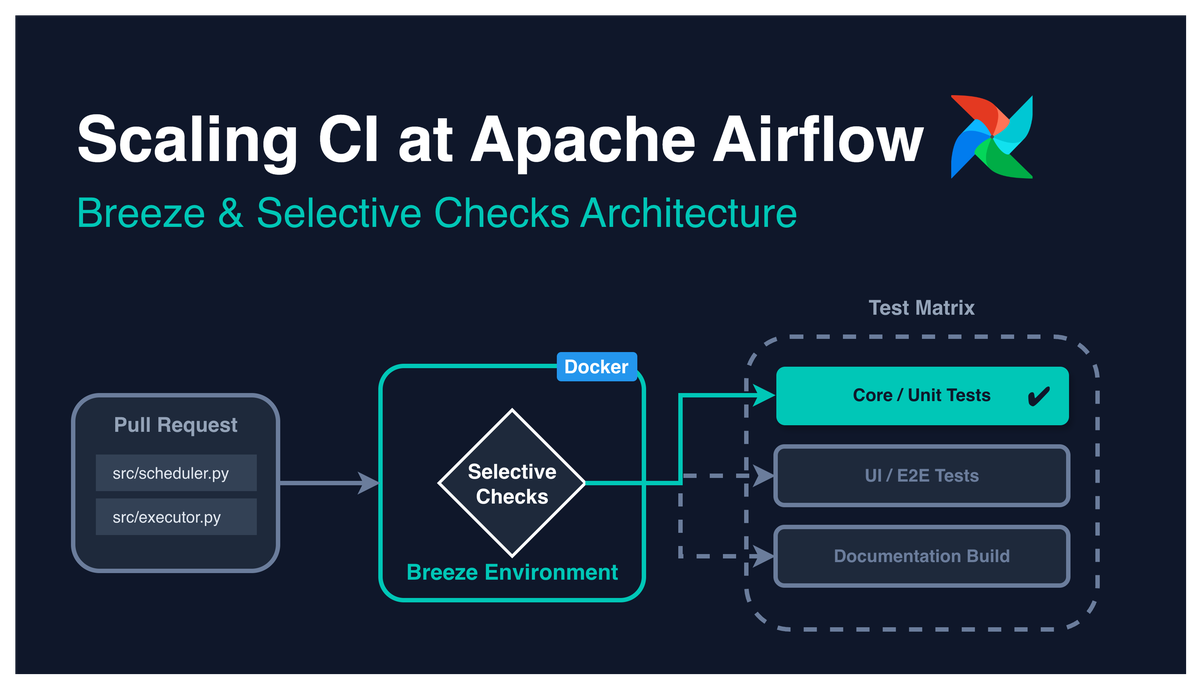
As mentioned at the beginning, Airflow triggers tens of thousands of GitHub Actions jobs every month. To avoid wasting resources, Airflow needs an automated mechanism to decide which tests should run based on what changed in a PR.
You probably don’t want a documentation-only PR to trigger heavyweight Kubernetes system tests. Conversely, if Kubernetes-related code changes do not trigger the relevant tests, that’s a serious problem.
At first, I assumed Selective Checks was mostly driven by PR labels applied by boring-cyborg. In practice, Selective Checks is primarily based on the set of files changed in the PR, and labels are only one possible additional signal.
Signals include:
- Changed files
- which subsystem they belong to (Core, Providers, UI, Helm chart, Kubernetes, Airflow CTL, Task SDK, etc.)
- number of files
- Special files (e.g.
pyproject.toml, CI framework internals) - GitHub Actions event (push, schedule, pull_request, etc.)
- PR labels (currently not tightly integrated with
area:xxxlabels)
In GitHub Actions, Airflow runs Selective Checks in the build-info job and publishes a set of flags for downstream jobs.
jobs:
# ...
  build-info:
    # At build-info stage we do not yet have outputs so we need to hard-code the runs-on to public runners
    outputs:
      # ...
      run-api-codegen: ${{ steps.selective-checks.outputs.run-api-codegen }}
      run-api-tests: ${{ steps.selective-checks.outputs.run-api-tests }}
      run-coverage: ${{ steps.source-run-info.outputs.run-coverage }}
      run-go-sdk-tests: ${{ steps.selective-checks.outputs.run-go-sdk-tests }}
      run-helm-tests: ${{ steps.selective-checks.outputs.run-helm-tests }}
      run-kubernetes-tests: ${{ steps.selective-checks.outputs.run-kubernetes-tests }}
      run-mypy: ${{ steps.selective-checks.outputs.run-mypy }}
      run-system-tests: ${{ steps.selective-checks.outputs.run-system-tests }}
      run-task-sdk-tests: ${{ steps.selective-checks.outputs.run-task-sdk-tests }}
      run-task-sdk-integration-tests: ${{ steps.selective-checks.outputs.run-task-sdk-integration-tests }}
      runner-type: ${{ steps.selective-checks.outputs.runner-type }}
      run-ui-tests: ${{ steps.selective-checks.outputs.run-ui-tests }}
      run-ui-e2e-tests: ${{ steps.selective-checks.outputs.run-ui-e2e-tests }}
      run-unit-tests: ${{ steps.selective-checks.outputs.run-unit-tests }}
      run-www-tests: ${{ steps.selective-checks.outputs.run-www-tests }}
      # ...
    steps:
    # some setup steps ...
    - name: "Install Breeze"
      uses: ./.github/actions/breeze
      id: breeze
    - name: "Get information about the Workflow"
      id: source-run-info
      run: breeze ci get-workflow-info 2>> ${GITHUB_OUTPUT}
      env:
        SKIP_BREEZE_SELF_UPGRADE_CHECK: "true"
    - name: Selective checks
      id: selective-checks
      env:
        PR_LABELS: "${{ steps.source-run-info.outputs.pr-labels }}"
        COMMIT_REF: "${{ github.sha }}"
        VERBOSE: "false"
      run: breeze ci selective-check 2>> ${GITHUB_OUTPUT}
Using Remove experimental note from EdgeExecutor #60446 as an example, below is what the build-info job produced.
Output from breeze ci get-workflow-info 2>> ${GITHUB_OUTPUT}
breeze ci get-workflow-info 2>> ${GITHUB_OUTPUT}pr-labels = ['backport-to-v3-1-test']
target-repo = apache/airflow
head-repo = eladkal/airflow
pr-number = 60446
event-name = pull_request
runs-on = ["ubuntu-22.04"]
canary-run = false
run-coverage = false
head-ref = edgeOutput from breeze ci selective-check 2>> ${GITHUB_OUTPUT}
breeze ci selective-check 2>> ${GITHUB_OUTPUT}GITHUB_OUTPUT content (stderr is redirected to ${GITHUB_OUTPUT})
all-python-versions = ['3.10']
all-python-versions-list-as-string = 3.10
all-versions = false
amd-runners = ["ubuntu-22.04"]
any-provider-yaml-or-pyproject-toml-changed = false
arm-runners = ["ubuntu-22.04-arm"]
['airflow-core/docs/core-concepts/executor/index.rst']
basic-checks-only = false
ci-image-build = true
common-compat-changed-without-next-version = false
core-test-types-list-as-strings-in-json = [{"description": "API...Serialization", "test_types": "API Always CLI Core Other Serialization"}]
debug-resources = false
default-branch = main
default-constraints-branch = constraints-main
default-helm-version = v3.17.3
default-kind-version = v0.30.0
default-kubernetes-version = v1.30.13
default-mysql-version = 8.0
default-postgres-version = 14
default-python-version = 3.10
disable-airflow-repo-cache = false
prod-image-build = false
provider-dependency-bump = false
providers-compatibility-tests-matrix = [{"python-version": "3.10", "airflow-version": "2.11.0", "remove-providers": "common.messaging edge3 fab git keycloak", "run-unit-tests": "true"}, {"python-version": "3.10", "airflow-version": "3.0.6", "remove-providers": "", "run-unit-tests": "true"}, {"python-version": "3.10", "airflow-version": "3.1.5", "remove-providers": "", "run-unit-tests": "true"}]
providers-test-types-list-as-strings-in-json = null
pyproject-toml-changed = false
python-versions = ['3.10']
python-versions-list-as-string = 3.10
run-airflow-ctl-integration-tests = false
run-airflow-ctl-tests = false
run-amazon-tests = false
run-api-codegen = false
run-api-tests = false
run-go-sdk-tests = false
run-helm-tests = false
run-javascript-scans = false
run-kubernetes-tests = false
run-mypy = false
run-ol-tests = false
run-python-scans = false
run-system-tests = true
run-task-sdk-integration-tests = false
run-task-sdk-tests = false
run-ui-e2e-tests = false
run-ui-tests = false
run-unit-tests = true
runner-type = ["ubuntu-22.04"]
shared-distributions-as-json = ["secrets_masker", "plugins_manager", "secrets_backend", "listeners", "dagnode", "configuration", "module_loading", "logging", "timezones", "observability"]
skip-prek-hooks = check-provider-yaml-valid,flynt,identity,lint-helm-chart,ts-compile-lint-simple-auth-manager-ui,ts-compile-lint-ui
skip-providers-tests = true
sqlite-exclude = []
testable-core-integrations = ['kerberos', 'redis']
testable-providers-integrations = ['celery', 'cassandra', 'drill', 'tinkerpop', 'kafka', 'mongo', 'pinot', 'qdrant', 'redis', 'trino', 'ydb']
ui-english-translation-changed = false
upgrade-to-newer-dependencies = false
stdout content:
Changed files:

('airflow-core/docs/core-concepts/executor/index.rst',)
FileGroupForCi.ENVIRONMENT_FILES did not match any file.
FileGroupForCi.API_FILES did not match any file.
FileGroupForCi.GIT_PROVIDER_FILES did not match any file.
FileGroupForCi.STANDARD_PROVIDER_FILES did not match any file.
FileGroupForCi.TESTS_UTILS_FILES did not match any file.
FileGroupForCi.ALL_SOURCE_FILES matched 1 files.
['airflow-core/docs/core-concepts/executor/index.rst']
FileGroupForCi.UI_FILES did not match any file.
FileGroupForCi.ALL_SOURCE_FILES enabled because it matched 1 changed files
SelectiveCoreTestType.API did not match any file.
SelectiveCoreTestType.CLI did not match any file.
SelectiveCoreTestType.SERIALIZATION did not match any file.
FileGroupForCi.KUBERNETES_FILES did not match any file.
FileGroupForCi.SYSTEM_TEST_FILES did not match any file.
FileGroupForCi.ALL_PROVIDERS_PYTHON_FILES did not match any file.
FileGroupForCi.ALL_PROVIDERS_DISTRIBUTION_CONFIG_FILES did not match any file.
FileGroupForCi.ALWAYS_TESTS_FILES did not match any file.
Remaining non test/always files: 1
We should run all core tests except providers. There are 1 changed files that seems to fall into Core/Other category
{'airflow-core/docs/core-concepts/executor/index.rst'}
Selected core test type candidates to run:
['API', 'Always', 'CLI', 'Core', 'Other', 'Serialization']
FileGroupForCi.DOC_FILES matched 1 files.
['airflow-core/docs/core-concepts/executor/index.rst']
FileGroupForCi.DOC_FILES enabled because it matched 1 changed files
FileGroupForCi.API_FILES disabled because it did not match any changed files
FileGroupForCi.ASSET_FILES did not match any file.
FileGroupForCi.ASSET_FILES disabled because it did not match any changed files
FileGroupForCi.ALL_PYPROJECT_TOML_FILES did not match any file.
FileGroupForCi.TASK_SDK_FILES did not match any file.
FileGroupForCi.TASK_SDK_FILES disabled because it did not match any changed files
FileGroupForCi.DEVEL_TOML_FILES did not match any file.
FileGroupForCi.ALL_AIRFLOW_PYTHON_FILES did not match any file.
FileGroupForCi.ALL_DEV_PYTHON_FILES did not match any file.
FileGroupForCi.ALL_DEVEL_COMMON_PYTHON_FILES did not match any file.
FileGroupForCi.ALL_AIRFLOW_CTL_PYTHON_FILES did not match any file.
FileGroupForCi.KUBERNETES_FILES disabled because it did not match any changed files
FileGroupForCi.HELM_FILES did not match any file.
FileGroupForCi.HELM_FILES disabled because it did not match any changed files
FileGroupForCi.TASK_SDK_FILES disabled because it did not match any changed files
FileGroupForCi.TASK_SDK_INTEGRATION_TEST_FILES did not match any file.
FileGroupForCi.TASK_SDK_INTEGRATION_TEST_FILES disabled because it did not match any changed files
FileGroupForCi.AIRFLOW_CTL_FILES did not match any file.
FileGroupForCi.AIRFLOW_CTL_FILES disabled because it did not match any changed files
FileGroupForCi.AIRFLOW_CTL_INTEGRATION_TEST_FILES did not match any file.
FileGroupForCi.AIRFLOW_CTL_INTEGRATION_TEST_FILES disabled because it did not match any changed files
FileGroupForCi.UI_FILES disabled because it did not match any changed files
FileGroupForCi.AIRFLOW_CTL_FILES disabled because it did not match any changed files
FileGroupForCi.API_CODEGEN_FILES did not match any file.
FileGroupForCi.API_CODEGEN_FILES disabled because it did not match any changed files
FileGroupForCi.GO_SDK_FILES did not match any file.
FileGroupForCi.GO_SDK_FILES disabled because it did not match any changed files
FileGroupForCi.JAVASCRIPT_PRODUCTION_FILES did not match any file.
FileGroupForCi.JAVASCRIPT_PRODUCTION_FILES disabled because it did not match any changed files
FileGroupForCi.PYTHON_PRODUCTION_FILES did not match any file.
FileGroupForCi.PYTHON_PRODUCTION_FILES disabled because it did not match any changed files
FileGroupForCi.ALL_PYTHON_FILES did not match any file.
FileGroupForCi.UI_ENGLISH_TRANSLATION_FILES did not match any file.- breeze/doc/ci - README
breeze ci selective-checkCLI entrypoint- The
SelectiveChecksclass (core logic that lists matched conditions)
Subsystem test job definitions#
Each subsystem test job consumes output flags from the build-info job and uses jobs.<job_id>.if conditions to decide whether it should run. This is how Airflow avoids unnecessary tests.
Most subsystem jobs only depend on needs: [build-info, build-ci-images], so they can run in parallel.
jobs:
# ...
  tests-helm:
    name: "Helm tests"
    uses: ./.github/workflows/helm-tests.yml
    needs: [build-info, build-ci-images]
    permissions:
      contents: read
      packages: read
    with:
    # partial list of inputs passed from build-info job
      runners: ${{ needs.build-info.outputs.runner-type }}
      platform: ${{ needs.build-info.outputs.platform }}
      helm-test-packages: ${{ needs.build-info.outputs.helm-test-packages }}
      default-python-version: "${{ needs.build-info.outputs.default-python-version }}"
      use-uv: ${{ needs.build-info.outputs.use-uv }}
    # only if helm tests are required
    # based on the selective checks output
    if: >
      needs.build-info.outputs.run-helm-tests == 'true' &&
      needs.build-info.outputs.default-branch == 'main' &&
needs.build-info.outputs.latest-versions-only != 'true'- Full
jobs.tests-helmdefinition: https://github.com/apache/airflow/blob/26a9d3b81b1d514ac00476885ba29676cd8f27e6/.github/workflows/ci-amd-arm.yml#L381-L382
Core decision logic#
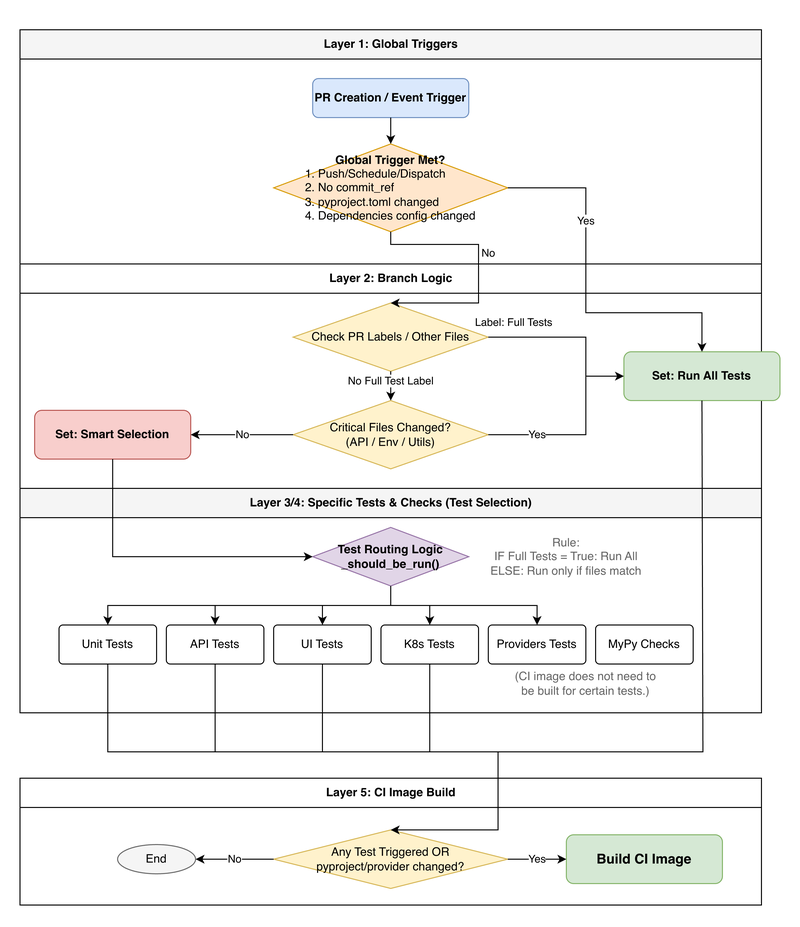
Layer 1: Global triggers → run the full suite
If any of the following is true, Airflow runs the full test suite:
- PUSH / SCHEDULE / WORKFLOW_DISPATCH GitHub event
- Missing
commit_ref, so the change set can’t be determined pyproject.tomlor other dependency/build config was changed- Provider dependency generated files were changed
Layer 2: Version selection → decide the test matrix size
| Label | Versions |
|---|---|
Global trigger OR all versions | All versions (Python/PostgreSQL/MySQL/Kubernetes) |
latest versions only | Latest versions only |
default versions only or no label | Default versions |
Layer 3: Test type routing → decide which tests to run
| Changed file category | Tests to run |
|---|---|
| Source code files | Unit tests, type checks |
| API-related files | API tests |
| UI files | UI tests, UI E2E tests |
| Kubernetes configs | Kubernetes system tests, Helm tests |
| Task SDK files | Task SDK tests |
| Go SDK files | Go SDK tests |
| Airflow CTL files | Airflow CTL tests |
| Environment/API/Provider configs | Run the full suite |
| Documentation files | Docs build |
Layer 4: Additional checks → static checks and scans
- Type checking (MyPy): when Python files change
- JavaScript scans: when production JavaScript changes
- Security scans (CodeQL): when any source code changes
Layer 5: Should we build the CI image? → build only when needed
- Any tests are triggered (unit/API/UI/Kubernetes/Helm, etc.)
pyproject.tomlchanged- Provider config changed
Practical examples#
| Scenario | What changed | Decision | Tests |
|---|---|---|---|
| UI-only change | frontend/src/App.tsx | Not full-suite + UI-only | Skip unit tests Run UI tests and UI E2E tests |
| Python source change | airflow-core/src/airflow/operators/bash.py | Not full-suite + source files matched | Run unit tests Run type checks (MyPy) |
pyproject.toml change | airflow-core/pyproject.toml | Dependency/build config changed | Full suite All versions |
| Scheduled run | SCHEDULE event | Global trigger matched | Full suite All versions All providers |
Summary#
Airflow’s CI architecture combines:
- Containerization for reproducible environments
- Breeze CLI to standardize contributor workflows and improve DX
- GitHub Actions outputs and conditions to build composable workflows
- Selective Checks to choose an appropriate test scope based on PR changes
This multi-layered decision system keeps CI both flexible and efficient. Selective Checks in particular helps skip unnecessary tests. For the detailed rules, see the Core decision logic section.
There’s also an important trade-off between “saving CI resources” and “test completeness.” In Airflow’s current Selective Checks behavior, changes to core often trigger a broad set of core tests (unit/API/system). That costs more, but maximizes safety. In the OpenSource4You Airflow meeting I discussed this with Chia-Ping, and the conclusion was: test completeness is more important than saving CI minutes.
Another thing worth noting: most subsystem tests run in parallel, but they commonly depend on build-ci-images to build the CI Docker image. Further optimizing build-ci-images can significantly improve end-to-end CI time.
If you want to dive deeper, here are some useful references: